For a Non-Governmental Organisation (NGO), obtaining registration under Sections 12A/12AB and approval under Section 80G is only the beginning. To continue receiving tax benefits and maintain credibility with donors, an NGO must follow regular reporting, accounting, audit and donation-related requirements.
Understanding the 12A 80G compliance requirements is therefore essential for every charitable trust, society or institution. Non-compliance can affect tax exemption, donor benefits and the organisation’s approval status.
This guide explains the major compliance requirements that NGOs should monitor every financial year.
What Are 12A and 80G Registrations?
Section 12A/12AB registration allows eligible charitable or religious trusts and institutions to claim exemption on qualifying income under the Income Tax Act, subject to applicable conditions. 12A registration for NGO is commonly used to describe this registration, although the current framework operates through registration under Section 12AB.
Section 80G approval, on the other hand, allows eligible donors to claim a deduction for qualifying donations made to an approved organisation, subject to the conditions of Section 80G.
Therefore, 12A/12AB primarily concerns the NGO’s tax exemption, while 80G is closely connected with tax benefits available to eligible donors.
What are the key 12A & 80G requirement for ngo’s?
The following are some of the most important requirements that should form part of an NGO’s annual compliance calendar.
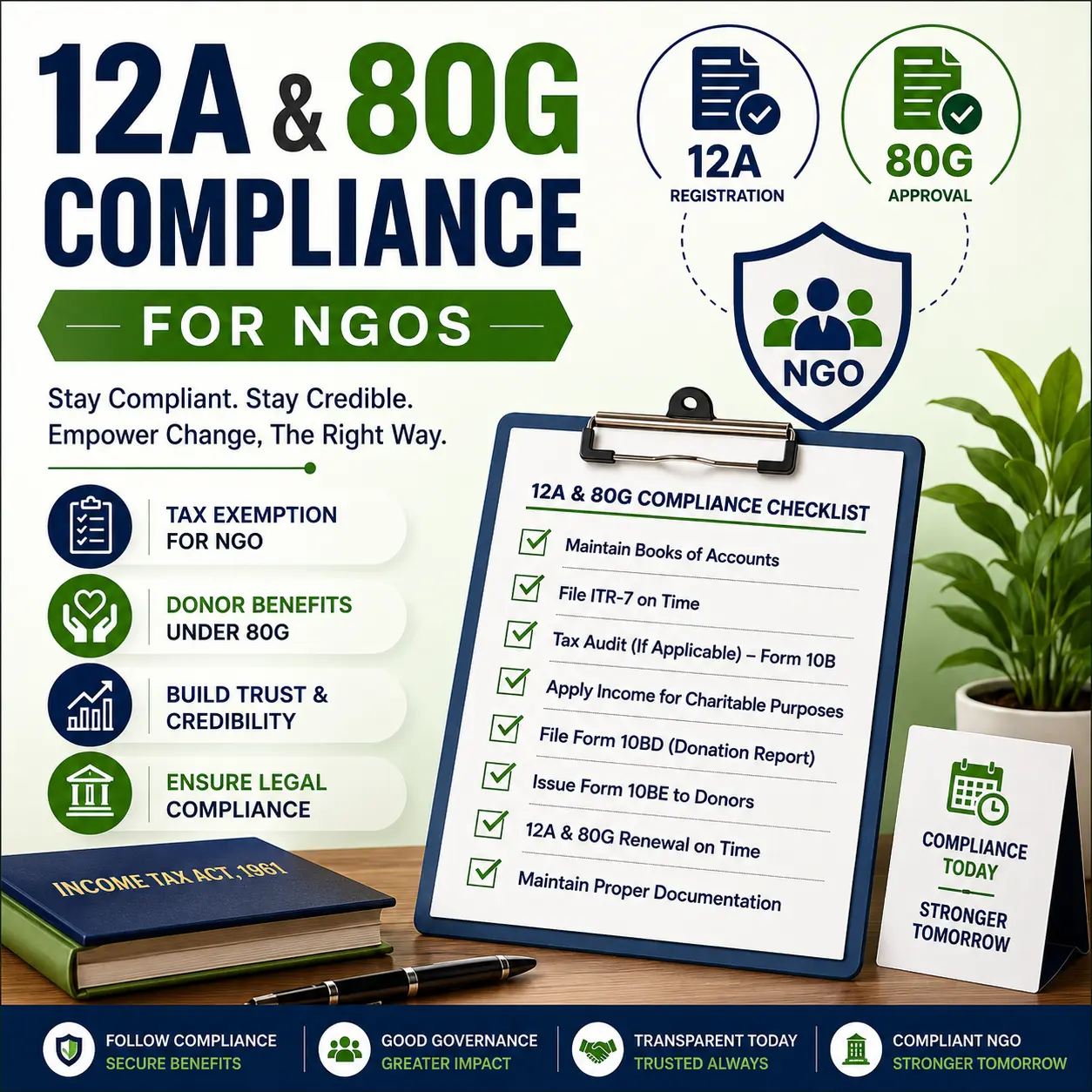
1. Maintain Proper Books of Accounts
An NGO should maintain accurate books of accounts and supporting records for its income, expenditure, donations, grants, investments and other financial transactions.
Donation receipts, bank statements, vouchers, invoices, project records and utilisation details should be properly preserved. Good accounting records make the annual return, audit and other statutory filings easier and reduce the risk of discrepancies.
2. File the Applicable Income Tax Return
Eligible charitable or religious trusts and institutions may be required to file ITR-7, depending on their status and the relevant provisions of the Income Tax Act. The Income Tax Department specifically identifies ITR-7 for persons required to furnish returns under provisions including Section 139(4A).
The return should accurately report the NGO’s income, application of income, donations, investments and other relevant information.
3. Complete Tax Audit Where Applicable
Tax audit requirements must be evaluated based on the applicable provisions and the NGO’s financial circumstances. Form 10B is the prescribed audit report for specified charitable or religious trusts and institutions under Section 12A.
An NGO should therefore review its audit applicability well before the income-tax return filing deadline.
4. Maintain the Required Application of Income
One of the important aspects of NGO tax compliance is the proper application of income towards charitable or religious purposes.
The Income Tax Department explains that, subject to the applicable conditions, income that is not applied may need to be accumulated through the prescribed mechanism. Form 10 and Form 9A can become relevant in specific situations involving accumulation or shortfall in application of income.
NGOs should maintain clear documentation showing how funds were used for their approved charitable objectives.
5. File Form 10BD for Eligible Donations
An NGO approved under Section 80G has an important donor-reporting responsibility. Form 10BD is used for reporting particulars of eligible donations received during the financial year.
The Income Tax Department states that Form 10BD is mandatory for applicable 80G-approved entities and is generally required to be furnished by 31 May immediately following the financial year in which the donation was received.
If no donation is received during the relevant financial year, Form 10BD is not required for that year.
6. Issue Form 10BE to Donors
After filing Form 10BD, the NGO must generate and provide Form 10BE to eligible donors. The certificate contains relevant details of the NGO, its 80G approval and the donation.
The prescribed deadline is also 31 May following the financial year in which the donation was received.
Accurate donor information is therefore extremely important.
What Is 12A 80G Renewal?
Registration and approval under the current tax framework are subject to prescribed validity and renewal procedures. NGOs should monitor the validity of their registration and approval and take timely action where a fresh application or renewal is required.
The 12A 80G renewal process should not be treated as a last-minute activity. The appropriate form and timing can depend on the nature and status of the existing registration or approval.
For this reason, NGOs should regularly check their registration orders, approval documents and the latest requirements on the Income Tax e-Filing portal.
Why NGO Annual Compliance Matters?
NGO annual compliance is important because maintaining registration alone does not guarantee continued tax benefits. The organisation must continue meeting applicable conditions relating to charitable activities, accounts, donations, tax returns, audits and statutory reporting.
For an organisation with 80G approval, donor reporting is particularly important because incorrect or incomplete donation information can affect the donor’s ability to claim the applicable deduction.
12A & 80G Annual Compliance Checklist for NGOs
Before closing each financial year, an NGO should review:
- Books of accounts and supporting documents
- Donation records and donor details
- Bank and investment records
- Application of income towards charitable objectives
- Audit applicability and Form 10B requirements
- ITR-7 applicability and filing
- Form 10BD donation reporting, where applicable
- Form 10BE certificates for donors
- Validity of 12A/12AB registration
- Validity of 80G approval
- Any applicable renewal or registration application
- Other statutory compliances applicable to the NGO
Following a structured compliance calendar can help an NGO avoid missed deadlines and maintain proper tax records.
KEY TAKEAWAYS
Proper NGO annual compliance is essential for maintaining the tax status and credibility of a charitable organisation. NGOs should not focus only on obtaining 12A registration for NGO or 80G registration for NGO. They should also maintain accurate accounts, file applicable returns and audit reports, report donations through Form 10BD, issue Form 10BE and monitor the validity of their registrations.
Because tax rules and prescribed forms can change, NGOs should verify the latest requirements on the Income Tax Department’s e-Filing portal before filing. A well-maintained compliance calendar can make NGO tax compliance more organised and help prevent avoidable defaults.
Important Frequently Asked Questions(FAQs) On 12A & 80G Compliance
Q1. Is 12A registration mandatory for an NGO?
Not every NGO automatically requires 12A/12AB registration, but an organisation seeking exemption under the relevant provisions for charitable or religious income generally needs to satisfy the applicable registration and compliance requirements.
Q2. What is the difference between 12A and 80G registration?
12A/12AB registration primarily relates to tax exemption available to an eligible charitable or religious organisation, subject to applicable conditions. 80G approval enables eligible donors to claim a deduction for qualifying donations made to the approved organisation.
Q3. Is Form 10BD mandatory for NGOs?
For an NGO or institution approved under Section 80G and covered by the applicable provisions, Form 10BD is mandatory for reporting qualifying donations received during the financial year. The prescribed due date is 31 May following the relevant financial year.
Q4. What happens if an NGO does not follow 12A and 80G compliance?
Failure to meet applicable requirements can lead to fees, penalties, difficulties in maintaining tax benefits or other consequences depending on the specific default. For example, the Income Tax Department states that delay in filing Form 10BD can attract a fee of ₹200 per day and penalties under the applicable provisions.