
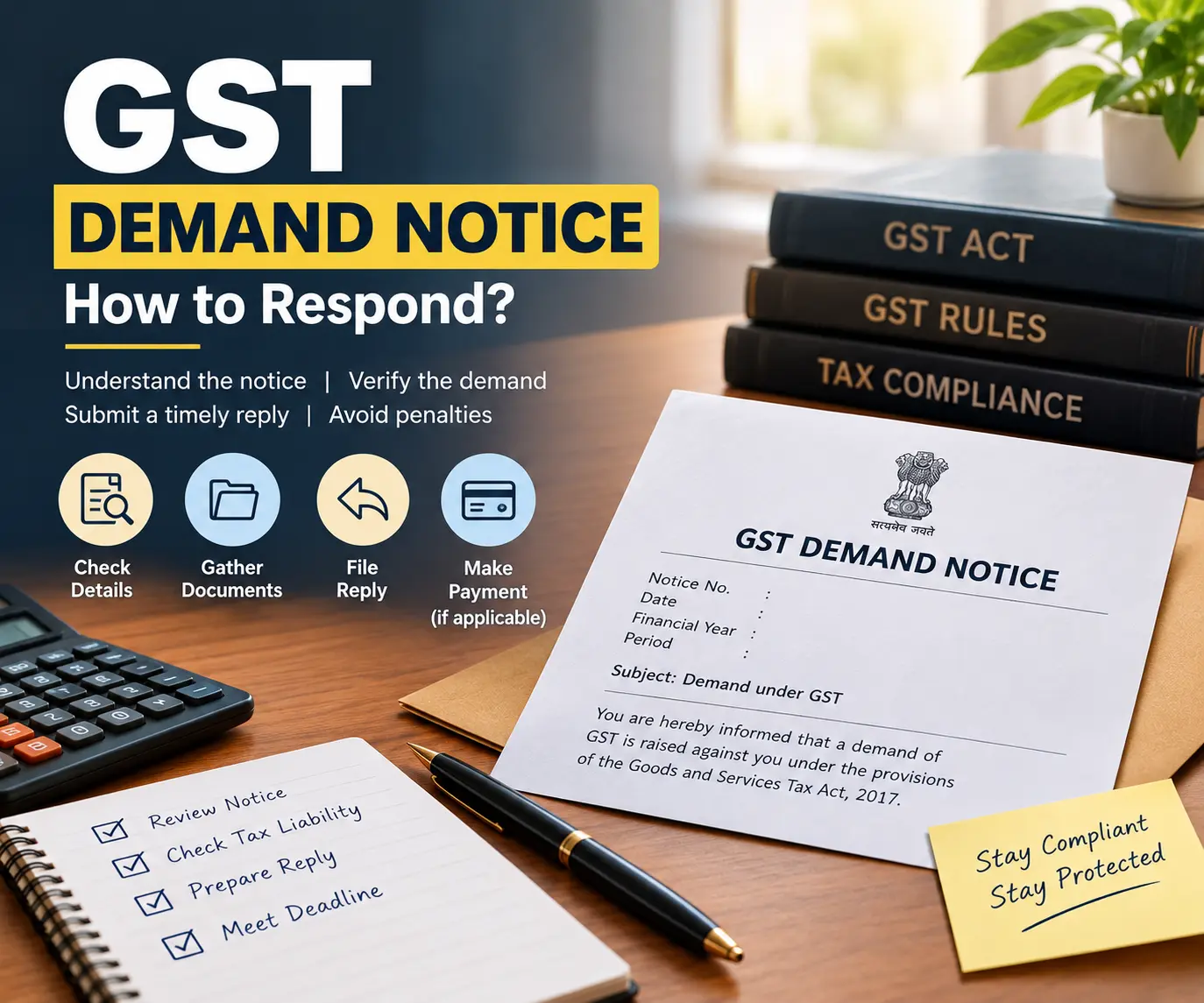
Receiving a GST demand notice can be concerning for any taxpayer, especially when it involves additional tax, interest or penalty. However, receiving a notice does not automatically mean that the demand is final or that you must immediately pay the entire amount. The correct approach is to carefully understand the reason for the demand, verify the figures and submit a proper response within the applicable time.
A gst notice may arise due to differences in GST returns, incorrect input tax credit (ITC), unpaid tax, classification issues, reporting errors or other compliance-related matters. Knowing how to respond can help taxpayers protect their rights and avoid unnecessary financial consequences.
What Is a GST Demand Notice?
A GST demand notice is issued by the proper officer when the department believes that tax, interest or penalty is payable by a taxpayer under the GST law. Depending on the circumstances and the applicable provisions, the proceedings may involve a show cause notice followed by an adjudication order.
For specified demand proceedings, the summary of a notice is communicated electronically in FORM GST DRC-01. A taxpayer’s representation or reply is generally furnished in FORM GST DRC-06, while a summary of the demand order is uploaded in FORM GST DRC-07.
The notice should not be ignored because failure to respond may result in further proceedings and recovery of the amount determined as payable.
What are the Common Reasons for a GST Demand?
A tax authority may raise a demand for several reasons, including:
- Difference between GST returns and other information available with the department
- Excess or ineligible input tax credit
- Short payment or non-payment of GST
- Incorrect reporting of taxable turnover
- Interest on delayed payment of tax
- Incorrect classification or tax rate
- Issues identified during GST scrutiny, audit or investigation
- Failure to comply with certain GST provisions
Before responding, the taxpayer should identify exactly what has triggered the demand and which tax period is involved.
How to Respond to a GST Demand Notice?
1. Read the Notice Carefully
First, check the notice number, date, financial year, tax period, applicable section, reason for the proposed demand and amount involved. Do not rely only on the total figure. Understand how the department has calculated the tax, interest and penalty.
2. Verify the Demand With Your Records
Compare the allegations with your GST returns, invoices, books of accounts, e-way bills, GSTR-1, GSTR-3B, purchase records and ITC reconciliation.
If the difference is caused by an accounting or reporting error, identify the exact transaction and determine whether the issue can be corrected under the applicable GST provisions.
3. Collect Supporting Documents
Documents may include invoices, payment records, purchase registers, sales registers, GST returns, reconciliation statements, credit or debit notes, e-way bills and previous correspondence with the department.
Strong documentary evidence can make the response clearer and easier for the officer to evaluate.
4. Prepare a Point-by-Point Reply
A good response should address every allegation separately. Explain the facts, provide the relevant documents and clearly state why the proposed demand is incorrect, if you dispute it.
Where only part of the demand is accepted, clearly distinguish the admitted amount from the disputed amount.
5. Submit the Reply Within the Applicable Time
The gst demand notice time limit is not necessarily identical for every GST proceeding. The applicable deadline depends on the section under which the notice has been issued and the circumstances of the case.
Therefore, taxpayers should follow the specific date mentioned in the notice and the applicable provisions rather than assuming that one general deadline applies to every case.
6. Consider Payment Where the Liability Is Admitted
If the tax liability is correctly payable and the applicable law permits payment at the notice stage, the taxpayer may consider making the required payment through the GST system.
Under the GST rules, certain payments made in connection with demand proceedings can be intimated through FORM GST DRC-03. The rules also provide specific consequences where tax and applicable interest or penalty are paid within prescribed periods.
GST Demand Notice Payment: What Should You Know?
GST demand notice payment should not be made blindly. First determine whether the demand is correct, whether any amount has already been paid and whether the notice contains calculation or factual errors.
A taxpayer should also distinguish between a notice proposing a demand and a final demand order. Once a demand order is issued, the amount may be reflected through the prescribed electronic GST records and may become subject to recovery proceedings if it remains unpaid. FORM GST DRC-07 is used for the summary of specified demand orders and is treated as the notice for recovery under the relevant rule.
What If You Disagree With the Demand?
If the taxpayer believes that the demand is incorrect, the appropriate response is to provide a factual and document-supported explanation within the prescribed time.
If an adverse order is ultimately passed, an appeal may be available under the GST law, subject to the applicable conditions, limitation period and requirements. Professional advice can be useful where the demand involves substantial tax, complicated ITC issues, interpretation of GST provisions or potential penalty exposure.
What are the Key Points to Remember?
- Never ignore a GST notice.
- Check the tax period and section mentioned in the notice.
- Reconcile the demand with your GST returns and books.
- Keep invoices and supporting documents ready.
- Respond within the applicable deadline.
- Do not make payment without first verifying the demand.
- Maintain proof of the reply and any payment made.
- Consider professional assistance for complex or high-value disputes.
Final Keytakeaways
A GST demand notice should be treated seriously, but taxpayers should first understand the basis of the demand rather than immediately assuming that the entire amount is payable. Checking the notice, reconciling GST records, preparing documentary evidence and submitting a timely response are important steps in handling GST demand proceedings.
For complicated matters involving significant tax, ITC disputes, interest or penalty, taking assistance from a qualified GST professional can help ensure that the response is properly prepared and supported by relevant records.
Important frequently asked question’s(faqs) on GST DEMAND NOTICE
Q1. What is a GST demand notice?
A GST demand notice is a communication issued by the proper officer when tax, interest or penalty is proposed to be recovered from a taxpayer under the applicable GST provisions.
Q2. What is the GST demand notice time limit?
There is no single time limit applicable to every GST demand proceeding. The applicable limitation and reply period depend on the relevant GST provision, tax period and circumstances. The taxpayer should follow the deadline specified in the notice and the applicable law.
Q3. How can I make GST demand notice payment?
The method depends on the stage and nature of the demand. In specified circumstances, payments connected with demand proceedings may be made and reported through FORM GST DRC-03. The taxpayer should verify the demand and applicable payment procedure before making payment.
Q4. What happens if I do not respond to a GST demand notice?
Ignoring the notice can result in further proceedings and, where a demand order is passed and remains unpaid, recovery action may follow. Therefore, the notice should be reviewed and responded to within the applicable time.